🤷🏻♂️
Lin 211 • Section 3, Part 6

2026-11-02
Read today: Pullum, Chapter 5
How is writing different from speaking?
Language in the World
Language existed before writing
- Our species is about 6 million years old
- Humans communicated through language long before the invention of writing
- Writing is only a few thousand years old
How many times was writing invented?
Writing has been invented at least three separate times:
- Mesopotamia — Cuneiform (~5,000 years ago)
- China — early Chinese (~3,500 years ago)
- Mesoamerica — Mayan (~3,000 years ago)
How many times was writing invented?
Writing has been invented at least three, maybe four(!), separate times:
- Mesopotamia — Cuneiform (~5,000 years ago)
- Egypt - Egyptian Hieroglyphics (~5,000 years ago )
- China — early Chinese (~3,500 years ago)
- Mesoamerica — Mayan (~3,000 years ago)
Surviving evidence of the first writing systems
| Region | Approximate early evidence | Example |
|---|---|---|
| Mesopotamia | Around 3400–3200 BCE | Cuneiform |
| Egypt | Around 3300–3000 BCE | Hieroglyphs |
| China | Around 1250 BCE | Oracle-bone inscriptions |
| Mesoamerica | First millennium BCE | Maya |
Writing is a technology that is usually borrowed
Cuneiform: writing with wedges
𒀀 𒂗
- Pictograms evolved into logograms representing ideas and phonograms representing whole syllables (a syllabary)
- Signs were impressed into clay with a reed stylus.
- The name cuneiform refers to its wedge-shaped marks (from Latin cuneo)
- Eventually used to write several languages, including: Sumerian, Akkadian, Babylonian, Elamite, Hatti, Hittite, Assyrian, and Hurrian

Egyptian hieroglyphs
𓂀 𓋹 𓊹
- Hieroglyphs appear on papyrus, monuments, objects, and tombs
- Important: Hieroglyphs are not simply pictures, they could be used three ways:
- Pictographic: Early forms evolved into
- Logographic: Signs representing words or concepts and
- Phonographic: Signs representing consonants (an abjad similar to modern Hebrew or Arabic)
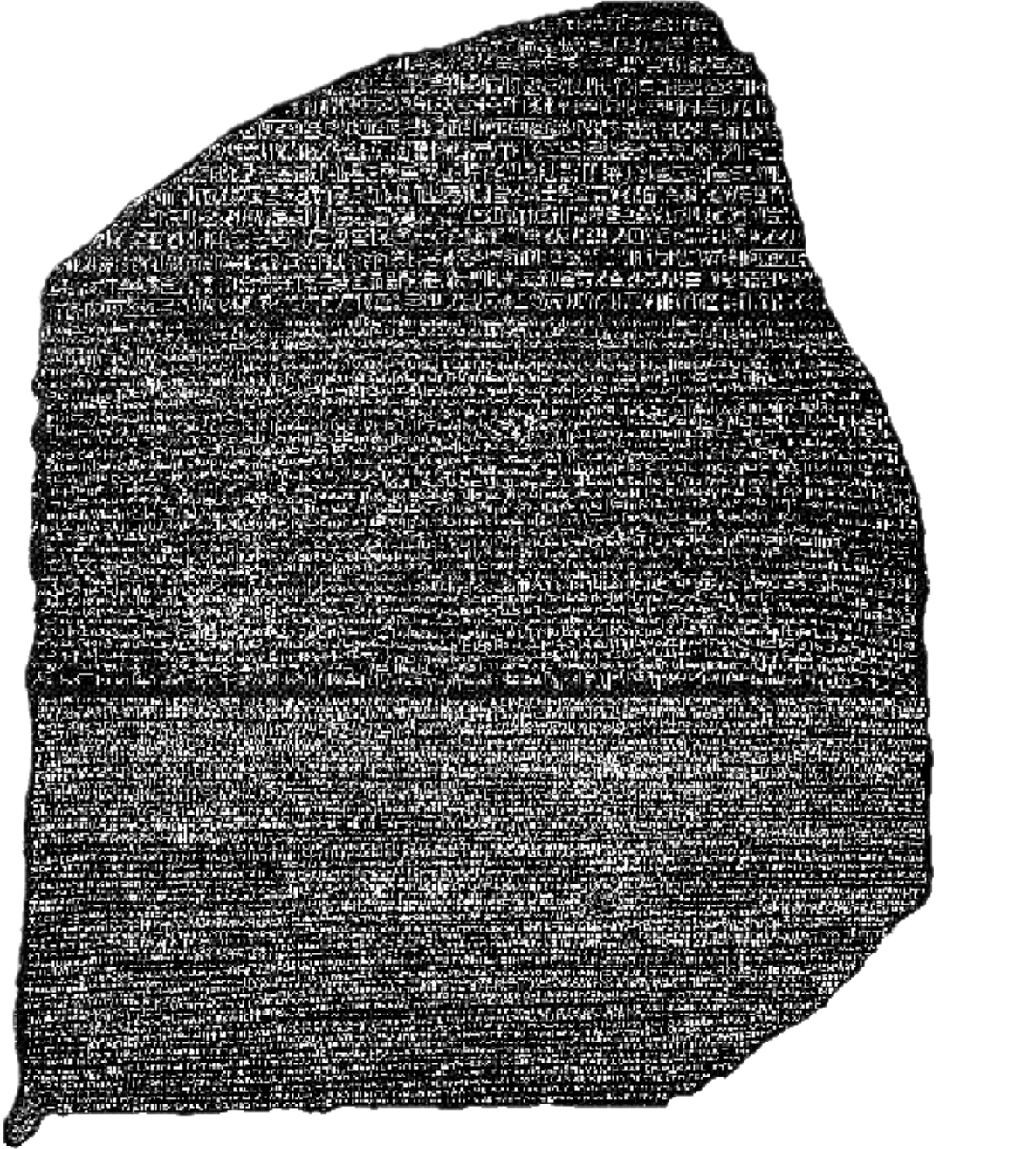
- We can read Egyption hieroglyphics today thanks to multilingualism
- The Rosetta Stone contains three nearly identical translations of a royal decree from 196 BC
- The top text is Ancient Egyption Hieroglyphs, the middle is Demotic script (a later phonographic Egyptian script), and the bottom is Ancient Greek
LING LINK
- Discussion Question: What kind of writing system does written English use? Pictographic, Logographic, or Phonographic
- Think about easy words like: big, sap, help, go
- But also harder words like: phlegm, eightth, psychology, judge, gym
English writing is phonographic
- We have symbols (borrowed from Latin, which also borrowed them) that more or less correspond to our consonant and vowel sounds
- How many sounds are there in a word like feather?
FEATHER
Consonant Sounds
- B C D F G H J K L M N P Q R S T V W X Y Z are not consonants. They are consonant symbols.
- The 25 American English consonant sounds are:

Vowel Sounds vs Vowel Symbols
- A E I O and U are not vowels. They are vowel symbols
- The ~17 American English vowels are:

Chinese characters
爱 禧 猫
Chinese writing uses characters that generally correspond to meaningful linguistic units, often morphemes, and have conventional pronunciations.
- Evolved from pictographic representations to logographs
- The only one of the 3 or 4 independently-invented writing systems that has remained in continuous use!
- Adopted by many cultures to write numerous languages including Japanese, Korean, and Vietnamese
- The same character may be pronounced differently in different contexts or varieties.
Maya writing: words and syllables
Maya hieroglyphs combined signs representing words with signs representing syllables.
- Used by Maya communities in Mesoamerica.
- Recorded names, dates, political events, and ritual information.
- Appeared on monuments, ceramics, and books.
- Much of the surviving script can now be read, though some signs and passages remain uncertain.
Maya writing encoded spoken languages; it was not simply a set of pictures.
One language can use multiple scripts, and one script can be used for multiple languages.
- Latin script: English, Turkish, Vietnamese
- Cyrillic script: Russian, Bulgarian, Tajik (a Persian language)
- Arabic-derived scripts: Arabic, Urdu, Farsi (a Persian language)
- Cuneiform: Sumerian, Akkadian, old Farsi (a Persian language)
- Chinese characters: Chinese and historically Japanese, Korean, Vietnamese, Zhuang
Emoji?
😭 👀 💀
- You tell me, are Emojis pictographic, logographic, or phonographic?
- Or maybe they do something else entirely when you use them?
- Discuss amongst yourselves
- Think about: generational differences, individual differences, regional/social differences(?)
Take aways
Language is not writing.
- Language is a feature of being human
- Writing is a technology for representing linguistic information
- Writing systems differ in how they represent words, syllables, and sounds
- Writing emerged independently in a small number of places and spread or developed like any technology
Arabic: an abjad
العربية
Arabic script is written from right to left.
- Letters primarily represent consonants (like Egyptian)
- Short vowels are typically omitted in ordinary writing
- Diacritics can mark vowels and other details when needed.
- Letter shapes change depending on their position in a word.
Arabic is a language; Arabic script is a writing system that is also used for other languages
Russian: the Cyrillic alphabet
Привет! Это русский язык.
Russian uses a version of the Cyrillic alphabet.
- Phonographic: Letters represent speech sounds.
- Some letters represent more than one sound or influence neighboring sounds.
- Spelling does not always correspond perfectly to pronunciation.
Cyrillic is a script, not a language.
It is also used by many other languages, including Bulgarian and Serbian, with differences between their alphabets.
Korean: Hangul
한글
Hangul is the writing system used for Korean.
- Developed in 1444 - 1446 under King Sejong the Great (r. 1418–1450)
- Its letters represent consonants and vowels.
- Letters are arranged into syllable blocks.
- Syllable blocks are not equivalent to Chinese characters
Korean is the language; Hangul is its writing system.
Language in the World